


5 mobile-first strategies to ensure contact data quality
Wed, 1st Apr 2026
It starts with a typo. A customer rushes through checkout on her phone, but her small touchscreen swaps "Maple Ave" for "Maple Avee." She doesn't notice, and neither does the retailer's system. Her package ships to nowhere. Meanwhile, another customer signs up for the loyalty app twice, creating duplicate records. He's already in the database from a web purchase, but now his profile lives in two different systems, each holding half the story of who he is, what he buys, and what he cares about. And that phone number you texted with a special offer? It's been recycled to someone new. You've just wasted marketing dollars and completely missed your target, a double hit to the bottom line.
Each small error chips away at the customer experience, causing failed deliveries, missed notifications, and irrelevant offers. And behind the scenes, analytics and personalization strategies quickly skew off course.
But this doesn't have to happen. Retailers that validate addresses, emails, and phone numbers in real time, at the moment of entry, stop "Maple Avee" before it exists. Those who maintain ongoing hygiene checks keep stale phone numbers fresh. Deduplication across every channel ensures each shopper is one customer with a single complete profile. And with address intelligence featuring ZIP+4 precision and residential/business address indicators, orders land exactly where they should.
For brands, mobile data quality isn't just back-end housekeeping. It's the difference between frustrated customers and frictionless experiences, between a lost sale and a loyal fan. It's simple: strong mobile data is just good business. How to make it happen? Here's Melissa's take on how smart data practices improve every step of the mobile customer journey.
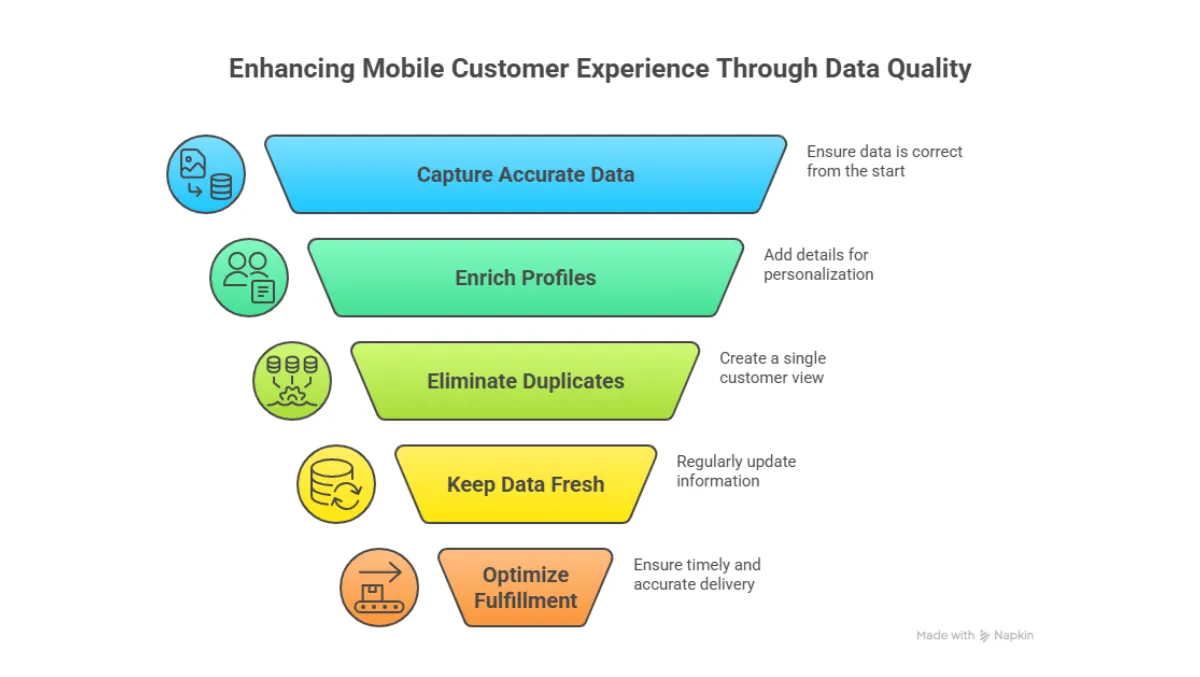
1. Capture Accurate Data from the First Tap
Your mobile checkout is often the first meaningful customer interaction. Make it count.
Mobile apps and mobile-optimized sites collect high volumes of names, addresses, emails, and payment details, but their quality depends on how well these inputs are validated in real time. Small screens, autocorrect mistakes, and typos increase the risk of errors.
Real-time validation and autocomplete, however, can stop bad data at the source. Cart abandonment is reduced, fulfillment accuracy is improved, and customers are reassured and confident that their order will arrive as expected.
2. Enrich Profiles for Personalization-at-Scale
Mobile shoppers expect relevant offers to land on their personal devices. If retailers want to nail precision targeting and real-time personalization, they need rich, complete customer profiles - think apartment numbers, demographics, even geolocation. With that kind of detail, SMS, push notifications, or in-app promos can actually land at the right moment, with the right message. But if contact data is wrong or incomplete, the offers miss the mark. Over time, that's how you lose opportunities and loyal customers.
3. Eliminate Duplicates for a Frictionless Journey
Mobile shoppers bounce between apps, browsers, texts, loyalty programs, you name it. Without good deduplication, one person can end up with multiple profiles across all those channels. That's how they get duplicate messages, repeat offers, or even conflicting recommendations.
Cleaning up those records into a single, unified profile means every interaction feels consistent. It builds trust, keeps the experience smooth, and cuts down on customer confusion.
4. Keep Data Fresh to Stay in Sync
Mobile contact information changes fast. Customers move, switch carriers, or change email addresses frequently, creating data errors compounded by the sheer scale of population size. Mobile numbers, in particular, are now a primary identifier for loyalty programs, promotions, and authentication, but they also decay quickly.
Ongoing data hygiene is critical. Regularly checking phone numbers, addresses, and emails makes sure your messages actually reach people when they should. Skip that step, and promotions never land, alerts get missed, and customers start to tune out.
5. Optimize Fulfilment with Address Intelligence
Checkout isn't the finish line for mobile shoppers. They expect fast, reliable delivery right to their door. Using smart address tools helps orders get to where they're going without delays or surprises. Address intelligence tools (such as Residential/Business indicators, ZIP+4 precision, and delivery zone analysis) help set realistic expectations, reduce failed deliveries, and lower shipping costs.
Accurate delivery information also improves transparency, leading to higher customer satisfaction and repeat purchases.
The Mobile Data Quality Imperative
A McKinsey report says 71% percent of consumers expect companies to deliver personalized interactions. And 76% percent get frustrated when it doesn't happen. Ouch. Facing stats like these, mobile-first brands must treat data quality as a customer experience imperative, not just an IT concern.
In mobile retail, the buyer's journey is fast, personal, and high stakes. When data is clean, customers feel understood, and that turns transactions into loyalty. "Over 70% of mobile searches lead to an action or sale within the hour vs. a desktop or laptop user taking up to a month to complete an action. As much as 79% of Americans have made online purchases, with 51% of them utilizing a mobile device for shopping online."
Today's shopper may even be mobile-only. In fact, m-commerce is projected to account for about 59% of all online retail sales worldwide in 2025, roughly $4.0 trillion in volume. With around 1.65 billion people, or 30% of internet users, shopping on mobile devices, it's a competitive fact that protecting and improving the customer's mobile experience is no longer optional.
Meeting the challenge demands close collaboration between data quality solution providers and eCommerce teams. Partnership between retailers and integrators allows tailored data quality solutions to the brand's exact needs. The same approach ensures that retailers aren't overpaying for data they don't need or missing out on essential features like address enrichment, identity verification, and fraud prevention.
In the mobile era (today and forever moving forward), customer journeys are defined by seamless transitions and relevant engagement. Smart data quality practices that embrace correct data entry, enrichment, and ongoing maintenance are crucial to this process. Treating mobile data quality as a cornerstone of customer experience gives retailers an edge, and the visibility and precision they need to win.