

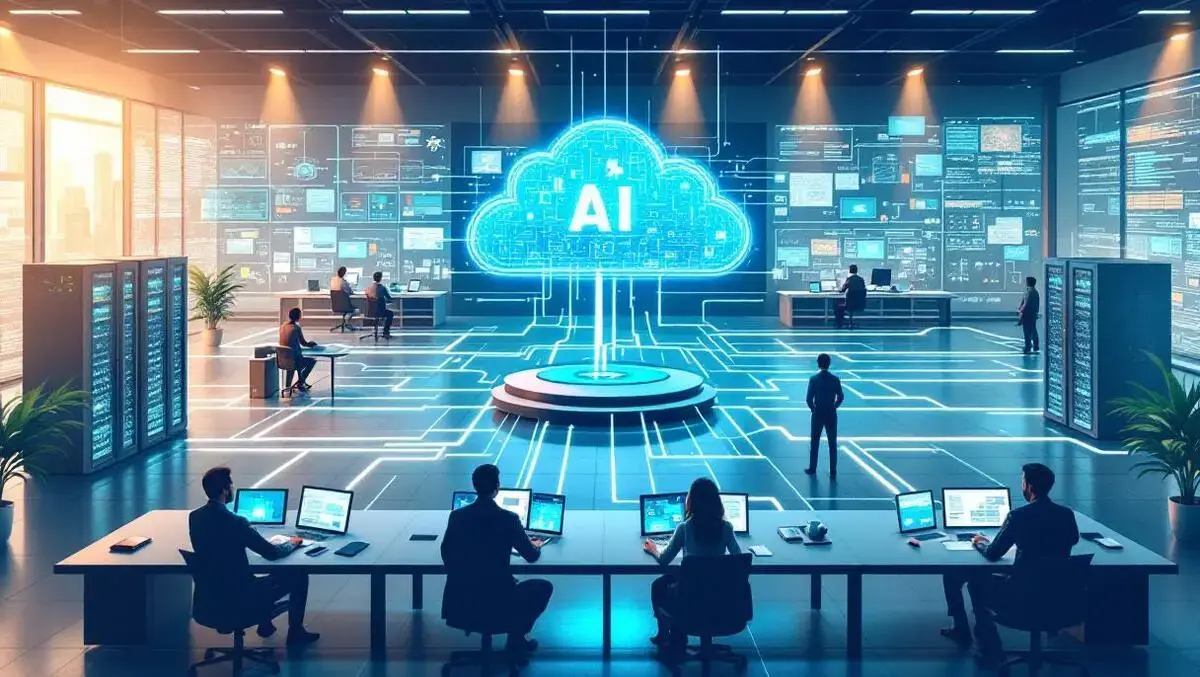
Stelia & Nokia team up on enterprise AI deployment
Fri, 27th Mar 2026
Stelia AI has partnered with Nokia to support enterprise AI deployment across distributed environments, with a focus on reliability, governance and connectivity for AI systems operating at scale.
The arrangement combines Stelia's AI platform with Nokia's networking technology to improve how AI workloads run across operational sites and cloud systems. It is aimed at businesses moving from pilot projects to broader production use, where performance and oversight become harder to manage.
Stelia already works in data-heavy enterprise environments where AI systems must meet governance and operational requirements. Nokia's role centres on open-standards-based networking designed to maintain stable data flows across dispersed infrastructure.
The collaboration reflects a broader shift in enterprise AI adoption. As companies apply AI to business processes rather than controlled test cases, they face more complex demands around compliance, auditability and secure connectivity, particularly for inference and agentic systems operating across multiple environments.
These demands have made the underlying network a more important part of AI deployment. In distributed setups, enterprises need to move data between sites, people and systems without interrupting service or creating governance gaps.
Stelia describes its platform as a full-stack AI system with built-in governance controls. Nokia says its networking technology supports secure and consistent information flows, which are necessary for AI tools to deliver predictable results in operational settings.
The partnership is positioned around sectors where data volumes and trust requirements are especially high, including space, media and entertainment, retail, and finance.
Industry shift
The announcement comes as enterprise buyers increasingly judge AI projects by operational outcomes rather than model experiments alone. That has pushed suppliers to address the practical realities of running AI continuously, including networking, oversight and resilience across mixed environments.
Dave Hughes, chief technology officer at Stelia, said the market needed to rethink how AI systems are built for wider use. "The industry needs to completely rethink how AI is architected as we move to outcome-driven engineering and production-grade resilience," Hughes said.
He added: "Success is no longer defined by the size of a GPU cluster in the middle of nowhere. It is defined by the ability to safely and effectively orchestrate a workload through all stages of the AI lifecycle, and connect systems, people, and data across entire organisations - enabling continuous, high-throughput, low-latency data movement across distributed infrastructure."
Network role
Nokia presented the collaboration as part of a broader focus on connectivity as AI deployments move beyond centralised computing environments. For network vendors, this creates an opportunity to argue that AI performance depends not only on compute resources, but also on the reliability and security of the infrastructure linking data sources and applications.
Paul Alexander, vice president and country manager at Nokia, said the network had become a central part of enterprise AI operations. "As enterprises deploy AI across increasingly distributed environments, the network becomes a critical foundation for performance, security and reliability," Alexander said.
He added: "Our collaboration with Stelia integrates Nokia's open, high-performance networking technology with Stelia's enterprise AI platform, helping organisations support demanding AI workloads while maintaining the trust, governance and connectivity required for real-world operations."
The work sits within Stelia's broader partner ecosystem, which focuses on AI use in environments where systems must be accountable and closely governed. The companies argued that enterprises now want AI deployments that can be audited, managed and maintained in the same way as other critical technology systems.
For suppliers, that means addressing a broader set of customer concerns than model accuracy alone. Buyers also want to know how AI can be connected across sites, monitored under pressure, and governed in regulated or operationally sensitive settings.
Stelia positions itself as an operational layer for AI in these environments. Nokia, meanwhile, is seeking to strengthen its role in enterprise connectivity by linking its networking portfolio more directly to the practical demands of AI deployment across distributed systems.
The collaboration highlights how enterprise AI spending is increasingly tied to infrastructure rather than software alone. As organisations look to run AI in day-to-day operations, providers are placing more emphasis on the mix of governance, networking and system reliability needed to keep those deployments running consistently.